
Climate-Controlled Storage in California: What You Need to Know (2026 Guide)
Will Your Belongings Survive A California Summer (And Wildfire Smoke)?
You came here for what actually matters, so start with this quick California heat test: it’s 3 p.m. in Madera, the car’s been parked for 20 minutes, and the cabin hits around 140°F. Reedley’s breeze carries fine ash, and by sundown a light gray film settles on everything. Lemoore’s afternoon spikes again. Those same conditions can hit storage: heat expanding and contracting, smoke slipping through gaps, boxes breathing in dust. Even sealed bins aren’t immune.Give your belongings the same test. Would a crayon, a candle, or a vinyl record survive an hour in that car? Tape a box and leave it in a hot garage—the adhesive softens and lifts. A guitar neck can warp; leather dries and cracks. Now picture that in a non‑sealed unit as temps swing day to night. One smoky week can sneak particles into paper fibers and electronics. That’s how warping, melting, and mildew start—quietly.Climate control means stable temperature, moderated humidity, and filtered air. Together they protect wood and leather from drying, electronics and media from heat stress, and photos, art, and documents from ash and dust. We build for Central Valley conditions, not buzzwords. Want to see what true climate control means in California—and what to ask on a tour?
What Climate-Controlled Really Means In California (Beyond Just A/C)
You just asked what true climate control means in California. Temperature-controlled means we hold air temperature in a set band—typically around 60–80°F—so items don’t bake or freeze. Climate-controlled adds humidity control (keeping relative humidity, or RH, roughly 40–55%) plus air circulation that avoids big swings. Humidity-controlled focuses on RH stability first, often paired with moderate temps. Ranges vary by building and season, but the goal stays the same: steady conditions, not peaks and valleys.Real climate control lives in a sealed, insulated building with interior corridors, filtered air, and continuous monitoring (sensors that alert us to drift). Temperature-only rooms or a wall A/C in a leaky structure don’t cut it. You want steady temps, stable RH, and clean air. On a tour, ask: Where are the sensors? How is air filtered during smoke season? Are door gaskets tight? How often are systems serviced? Short-term, rugged items might skip it; valuables shouldn’t.Now, layer in California’s microclimates. Central Valley summers push triple digits with dust; coastal zones bring fog and higher RH; Sierra foothills see cold snaps; late summer adds wildfire smoke. Electronics hate heat and particulates. Wood and leather crack when RH drops, then swell when it spikes. Fabrics and paper absorb moisture and odor fast. That’s why climate control here means temperature, humidity, and filtration working together.
The Hidden Damage California Heat, Humidity Swings, And Smoke Can Cause
One hot weekend in Fresno County can warp vinyl records left near a metal wall; they don’t return to flat. Two months in a dry, unconditioned unit and a guitar neck creeps, then a foggy week swells the wood—now it won’t hold tune. After a smoky, humid stretch, mattresses spot with mildew at the corners you can’t see until it’s too late. Appliances stored through summer pick up corrosion on coils. Photos left in fluctuating heat bleach at the edges, and paper files get brittle when RH swings.In Madera, we’ve seen packing tape slump open after a few blazing afternoons—boxes breathe, dust sneaks in. Candles, cosmetics, and adhesives soften, then re‑harden into odd shapes. A leather sofa dries and cracks along seams after six weeks of low RH, while particleboard furniture delaminates when a damp spell follows. Camera lenses can haze as smoke particulates mix with moisture. Even sealed bins track odors. Two seasons in storage, and small, daily swings add up to permanent changes.Here’s the practical science: heat speeds up chemical reactions and softens glues and plastics. Relative humidity (RH) swings make wood, paper, and fabrics expand and contract, stressing joints and fibers. Smoke carries micro‑particles that settle into textiles and coatings, embedding odor and residue. Cardboard slows dust, but it’s not a true barrier; fine ash and moisture still penetrate. Stability and filtration prevent that slow, cumulative damage.Basic A/C can flatten peak temperatures, but it rarely manages humidity stability or serious filtration—the pillars that matter during Valley heat and smoke. If a space cools but still swings wet‑dry or breathes ash, sensitive items remain at risk. So what fails in those “good enough” setups, and how do you spot it before you sign?
Why Basic Temperature Control Isn’t Enough Year‑round In California
Temperature-only systems ignore RH, so a rainy week or coastal fog can push moisture up even while the thermostat reads fine. Filtration varies wildly—some places run coarse pre‑filters that miss smoke particles. Older buildings develop hot spots near the sun‑facing walls and roofs. Then come Public Safety Power Shutoffs (PSPS, planned outages during fire risk) and routine summer brownouts. Without backup plans, interior temps and RH drift exactly when you need stability most. That’s when adhesives slump, finishes craze, and electronics see repeated thermal stress.Even inside one facility, conditions can vary by bay and floor. Units abutting exterior masonry or above office mezzanines often run warmer; corners can be drafty; older roll‑up doors leak dust. Fans may just move warm, dusty air around instead of filtering it. Sensor placement matters too—one probe by the office isn’t proof of stability down your corridor. Ask about door seals, insulation upgrades, filter ratings (look for fine particulate capture), and service cadence. The goal isn’t perfect numbers—it’s tight, predictable ranges in every unit.Now zoom out over time. Daily swings, even small ones, stack into warped veneers, fogged optics, and brittle paper after a season or two. Instruments, photos, records, comics, and collectibles care as much about RH and air quality as temperature. If you’re storing beyond 30–90 days, the stakes rise. Next, we’ll give you a simple framework to choose the right type of unit with confidence.
Match The Control Level To What You’re Storing
So here’s that simple framework. Pick from three tiers: Drive-up (no conditioning), Interior temperature-controlled (cooling, ~60–85°F), and Full climate-controlled (temperature, humidity, filtration). Choose based on three factors: item sensitivity to heat/dust, storage duration (30 days vs 6–12 months), and California location (Central Valley heat, coastal fog, smoke season). Short stay with rugged goods? Drive-up. Valuables, media, or summer‑through‑fall storage? Choose climate control.
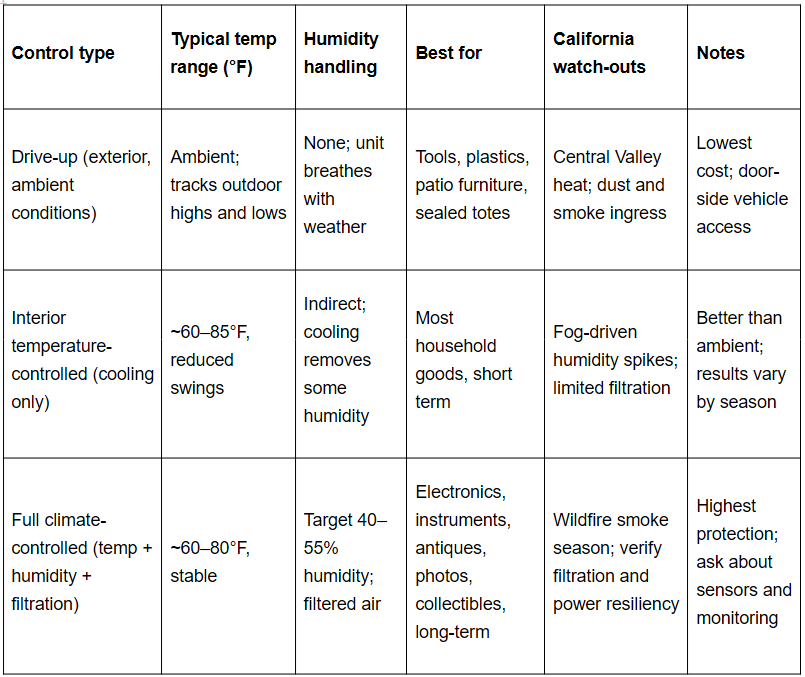
Pro tip: Ask for typical set points (temperature and humidity) and whether both are monitored continuously with alerts. During wildfire season, confirm filtration level and filter change cadence, and ask if they capture fine smoke particulates and how they handle power outages or planned fire‑risk shutoffs.
How Master Storage 365 Does Climate Control In Madera, Reedley, And Lemoore
You asked about set points, filtration, and outage planning—here’s how we handle it locally. Our climate-controlled buildings target roughly 60–80°F with moderate humidity, and we filter air buildings‑wide to cut smoke and dust. We monitor conditions continuously and respond fast if they drift. Access stays easy: 24-hour entry, keyless access, and free Wi‑Fi (wireless internet). For business users, extra‑large units can be customized with features for racking, staging, or workflow needs. We’re near Highway 99 in Madera, close to the Kings River and Reedley College, and convenient to NAS (Naval Air Station) Lemoore.Interior corridors and sealed doors cut dust transfer, and our filtration helps during wildfire weeks. Mailing services on‑site make inventory handling simpler. Think practical: a photographer grabs gear with keyless access; an e‑commerce seller stages shipments in a cool, stable unit. Extra‑large spaces scale with your season. Prefer fast move‑ins? Pull off Highway 99 at Knox Rd. in Madera, swing by Reedley after classes at Reedley College, or access from base housing near NAS Lemoore. Tour in minutes; we’ll show you sensors and typical ranges. Next, let’s sort what belongs in climate control vs drive‑up.Local Contact:Questions about availability or sizes? Call 559-664-3910 or stop by 905 Knox Rd., Madera, CA 93638. We’ll check openings and recommend a fit in two minutes.
What Belongs In Climate‑controlled Storage (Especially In California)
We can recommend a fit in two minutes, but here’s your protection checklist. Scan the bold labels and the California-specific why—heat, RH (relative humidity) swings, and smoke—so you know what truly needs climate control.
- Electronics: Heat stresses circuits; smoke particulates infiltrate vents; RH (relative humidity) swings cause condensation that corrodes boards and contacts.
- Musical instruments: Wood expands/contracts with RH swings, weakening glue joints; heat and dryness throw tuning wildly off.
- Vinyl & media: High Valley temps warp records and tapes; prolonged heat degrades adhesives and magnetic layers.
- Photos & art: Heat and RH swings curl paper; smoke/soot leaves residue that stains and embeds odor.
- Mattresses & upholstery: Moisture and RH spikes invite mold and mildew; smoke odor clings to fibers.
- Antiques & wood: Repeated expansion/contraction from RH swings cracks finishes, loosens joints, and warps veneers.
- Collectibles: Paper cards and comics turn brittle with heat; smoke odor and soot permanently devalue graded items.
- Documents & books: Paper acidity accelerates in heat; RH swings ripple pages and encourage mold in bound spines.
- Appliances/metal: RH swings create condensation on coils and tools, driving corrosion and rust; dust reduces efficiency.
- Wine/specialty: Needs tight temperature and true humidity control; general climate control helps, but ask about dedicated conditions.
What’s Usually Safe In A Drive‑up Unit (And How To Pack It)
If wine and specialty items need tight control, plenty of everyday gear does fine in drive‑up storage. These tolerate heat and RH (relative humidity) swings better—just use sealed totes and smoke‑resistant wraps during fire season. To compare options and save smart, check our Drive-Up Storage Units.
- Tools and hardware—light oil wipe against corrosion
- Plastic patio furniture—cover to reduce UV dusting
- Non-sensitive sports gear—dry thoroughly before storage
- Seasonal decor in sealed totes—label smoke-season totes
- Automotive accessories—avoid fluids and hazardous materials (hazmat); clean first
- Outdoor equipment—brush off ash; use breathable covers
How To Choose The Right Storage Type In California (Step‑by‑step)
After those drive‑up packing tips (brush off ash, breathable covers), let’s pick your unit with a fast 6‑step checklist—prioritizing item sensitivity, how long you’ll store, and Central Valley heat/smoke.
Step 1: Inventory:
List everything, then group by sensitivity—electronics/media, wood/leather, paper/textiles, and rugged gear. Flag valuables. Photos and instruments usually demand climate control; plastic bins usually don’t.
Step 2: Duration:
The longer you store, the bigger swings get. For 90+ days—especially summer into fall—lean climate control. Under 30 days with rugged items? Drive‑up can work.
Step 3: Location:
Central Valley heat and dust demand more protection; coastal fog raises humidity (RH, moisture). Plan for wildfire smoke during summer/fall—filtration matters for paper, fabrics, electronics.
Step 4: Access needs:
If you’ll visit daily or load heavy items, drive‑up is convenient. For late‑night, weather‑proof visits, interior corridors with keyless entry and 24/7 access win.
Step 5: Availability & size:
Measure volume, leave aisle space, then check openings and pricing—start with our self storage units in Reedley, CA for options and sizes.
Step 6: Confirm controls:
Ask for temperature and RH set points, filtration level for smoke, sensor coverage, and alerts. Prefer stable ranges, tight door seals, and documented maintenance.
Before Move-In: California-Smart Prep Checklist
Now that you’ve confirmed set points, filtration, and seals, we prep smart. These steps cut heat, humidity, and smoke risks; 15 minutes prevents months of damage. Costs and ROI next.
- Clean: Wipe electronics and metal; fully dry fabrics and wood before boxing.
- Seal: Use gasket totes; bag textiles in breathable covers to block smoke.
- Buffer: Add desiccant packs inside moisture‑prone boxes and bins, especially papers and fabrics.
- Elevate: Keep boxes off the floor with pallets or shelving, leaving a small aisle.
- Wrap: Use smoke‑resistant plastic on totes and shelving; never wrap directly on wood or leather.
- Label: Mark sensitive items, orientation arrows, and room; list contents on at least two sides.
- Document: Photograph serial numbers and condition; save a quick inventory for insurance.
- Plan: Move in mornings or evenings; avoid peak heat and keep doors closed between loads.
Costs, Sizes, And How To Judge Value In California
While you plan that early‑morning move‑in and keep doors closed between loads, the next question is cost. Yes, true climate control carries a premium over ambient drive‑up, but it’s insurance for heat‑, humidity‑, and smoke‑sensitive items. One warped record collection or a cracked guitar neck can equal $500–$1,000 in losses—far more than a modest monthly difference.
- Premium range: Expect a moderate premium vs drive-up; it varies by season, location, and availability
- Duration matters: The longer you store, the more climate control pays off—especially through summer and wildfire season
- Right sizing: Measure couches, mattresses, or racks; plan vertical stacking and an aisle so you avoid renting extra space
- Business use: Extra-large, customizable units can replace overflow warehouse space and reduce last‑mile trips, staging costs, and heat‑damage risk
Two California Stories: When Climate Control Saved The Day
Those savings on heat damage and logistics are real—we see them every week. A Reedley piano teacher stored an upright and six boxes of sheet music from July through the smoky weeks. She toured both options and chose our climate-controlled interior for steady temperature and filtered air. When she rolled it out on August 28 for her September 1 recital, the tuner needed only a light touch. No smoke odor on the hammers, and the sheet music stayed crisp and flat.We placed the piano along an interior wall with a small aisle, used a breathable cover (no plastic wrap on wood), and added desiccant packs inside the bench. Her humidity card hovered 45–50% RH (relative humidity), and temps stayed roughly 60–78°F. She used keyless entry for quiet practice before school two mornings a week. Result: clean tone, no sticky keys, and every score smelled like paper—not ash. If you’re storing an instrument, this is the playbook.Madera case: an e‑commerce seller rotated fall electronics and apparel. We set them up in a climate‑controlled unit near Highway 99 for quick carrier pickups, with 24/7 access and keyless entry so late drops were easy. Free Wi‑Fi (wireless internet) kept inventory synced. After one season, heat‑ and moisture‑related returns fell about 30%, and fewer items needed reboxing. The team saved hours by staging indoors, then rolling to the loading area at dawn. If you run a shop, that's the margin you keep.
California Climate-Control Storage Faqs
Keeping that margin matters. Now, quick answers to the California questions we get about climate control, smoke season, outages, sealing, prohibited items, and 24/7 access—so you can decide fast.
Do you control humidity as well as temperature?
Yes—climate-controlled buildings target stable temperature and relative humidity (RH), monitored continuously. We aim for mid-range RH, reducing swings that warp wood, photos, and adhesives.
How does filtration help during wildfire smoke?
We use high‑efficiency filters rated for fine smoke particles and increase change frequency in season. Filtration reduces ash and odor; pack textiles with charcoal sachets for odor control.
What happens during power outages/PSPS?
During PSPS (Public Safety Power Shutoffs) or outages, insulation helps retain conditions. We monitor, prioritize restoration, and post‑event checks. Use desiccants and keep doors closed to maintain stability.
Are units sealed against dust/ash?
Interior corridors and gasketed doors reduce dust/ash, but no building is 100%. Use sealed totes, tape seams, breathable covers for wood/leather, and desiccants. Avoid cardboard-only during smoke season.
What items are prohibited in CA storage?
No flammables or hazardous materials: fuel, paint, solvents, fireworks, explosives, compressed gas; no perishables, live plants/animals, or illegal goods. When unsure, ask—we’ll check local rules together.
Can I access my unit 24/7?
Yes. We offer 24-hour access with keyless entry at participating locations. Set digital keys for family or team members. Call ahead to confirm activation for your specific unit.
Ready For 24/7, Keyless, California‑smart Protection?
You can activate 24-hour access and keyless entry now in Madera, Reedley, or Lemoore—reserve our climate-controlled storage units in minutes. Stable temps, filtered air, and interior corridors protect what heat, dust, and smoke don’t. Prefer a quick tour? Call and we’ll match you to the right size today.